
Differences present from birth, corrected with staged, age-appropriate surgery. Timing is planned around the child’s growth rather than the calendar.
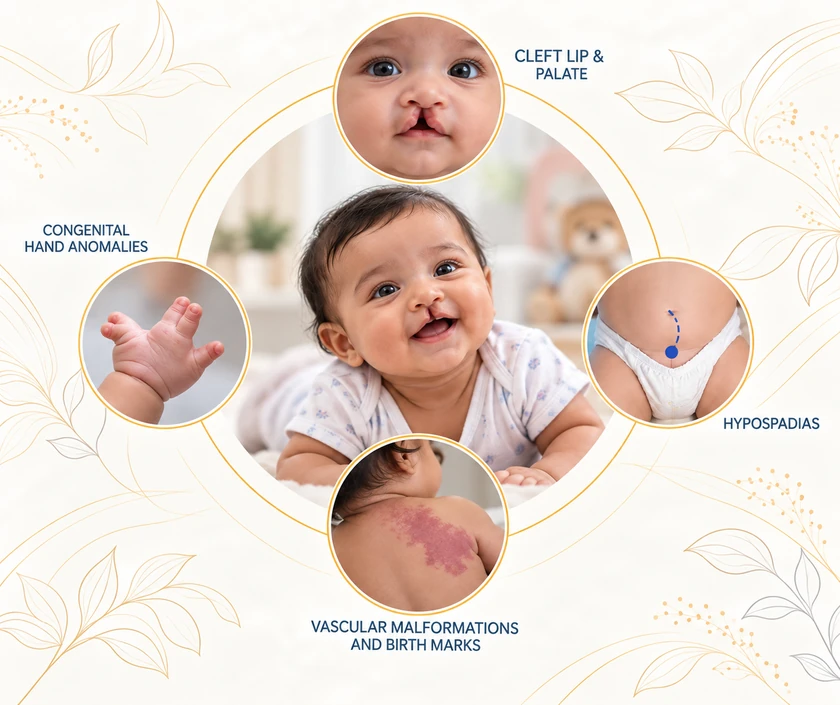
A congenital anomaly is a difference in the way part of the body formed before birth. Nothing a mother did or did not do during pregnancy causes it, and families are told that plainly, because the guilt is often heavier than the condition itself.
These conditions are corrected in stages across childhood rather than in one operation. Each stage is timed to the child’s development, so a palate is repaired before speech forms and a bone graft waits for the tooth it must support. Families are given the whole map at the start rather than one step at a time.

Staged repair of cleft lip and palate from infancy, with feeding, speech, hearing and dental care planned around the child’s growth.
Learn more
Correction of extra, joined or underdeveloped fingers and thumbs, timed to the child’s development so the hand grips, pinches and grows.
Learn more
Repair of a urethral opening on the underside of the penis, with straightening of the shaft, usually in a single operation in infancy.
Learn more
Diagnosis and treatment of birth marks, from infantile haemangioma and port wine stain to venous, lymphatic and arteriovenous malformations.
Learn moreEach stage is planned around growth and development, not the calendar. Operating too early can be undone by the growth still to come.
Cleft and congenital care needs a paediatrician, an anaesthetist, a speech therapist, an orthodontist and an ENT surgeon at different points over years.
A hand is judged on whether it grips and a palate on whether speech forms. Appearance is refined afterwards rather than driving the plan.
Small children need anaesthesia and monitoring built for them. Theatre and critical-care infrastructure is available around the clock at Kiran Hospital.
It depends on the condition. A cleft lip is usually repaired at three to six months and the palate at nine to eighteen months, joined fingers are separated at around twelve to eighteen months, and hypospadias is repaired between six and eighteen months. In every case the child’s fitness for anaesthesia comes before the ideal age.
Often yes. Cleft care in particular runs in stages across childhood, with a bone graft to the gum at around eight to eleven years and any surgery to the nose or jaws left until growth is complete. The full plan is explained at the first consultation rather than one stage at a time.
In most children no single cause is found. Genetic factors, family history and events in early pregnancy all contribute, and a difference is sometimes part of a wider syndrome, which is why the whole child is examined rather than only the affected part.
Families who want a figure for recurrence are referred for genetic counselling rather than given a guess. It depends on the condition, on whether it is isolated or part of a syndrome, and on the family history.
Cover for congenital conditions varies between policies and some apply a waiting period. Several government schemes in India support children’s congenital care. The hospital team helps with documentation and pre-authorisation, and cover is confirmed with the insurer before surgery is scheduled.
Consultations at Kiran Hospital, Katargam, Surat. NRI and outstation patients can request a video consultation.