
Time-critical, technically demanding surgery that reattaches, rebuilds and restores. Gujarat's first hand transplant was performed by this team.
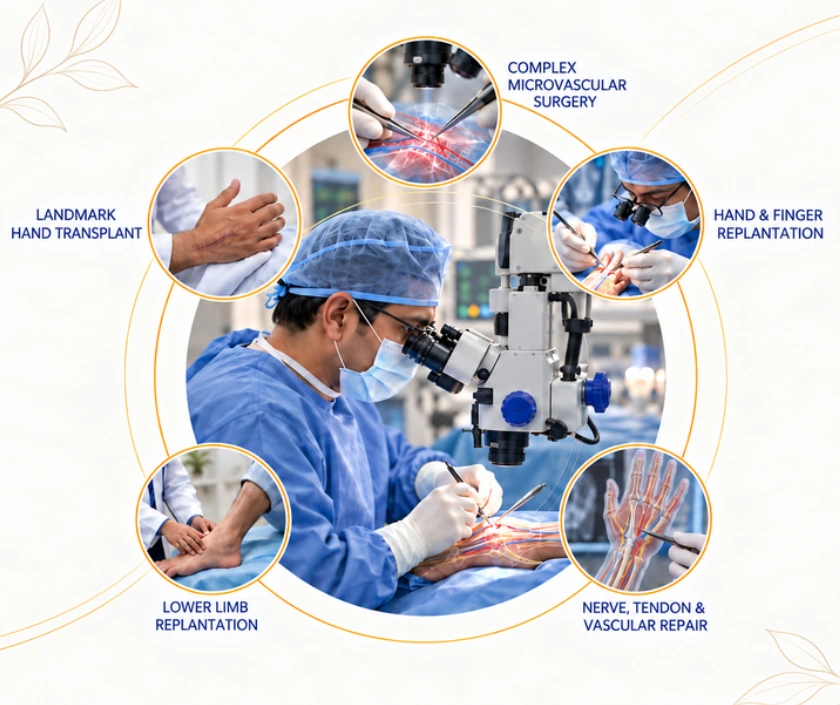
Microsurgery means operating under a microscope on vessels and nerves roughly a millimetre across. It is what makes it possible to reattach an amputated hand, move living tissue across the body, or transplant a limb from a donor.
Dr. Arvind Patel leads vascularised composite allotransplantation in Gujarat and performed the state's first hand transplant, with four successful hand transplants completed to date. He has carried out around 500 replantations of amputated parts and completed supermicrosurgery training in Jinan, China and lymphoedema surgery training at NCGM, Tokyo.
If an amputation has just happened, do not wait. Wrap the amputated part in clean moist gauze, seal it in a plastic bag, place the bag on ice without letting ice touch the tissue directly, and call the emergency line immediately. Replantation is time-critical and earlier surgery improves the chance of success.

The case, the team and the outcome behind Gujarat's first hand transplant.
Learn more
Vessels rejoined under the microscope so transferred tissue survives and works.
Learn more
Emergency reattachment of amputated fingers and hands.
Learn more
Salvage and reattachment after severe leg and foot amputation injuries.
Learn more
Microsurgical repair to bring back movement, sensation and blood supply.
Learn morePerformed by this team, with four successful hand transplants completed to date and covered in regional and national press.
Emergency reattachment of amputated fingers, hands and limbs, one of the largest such experiences in the region.
Supermicrosurgery training at Jinan, China and lymphoedema surgery at the National Center for Global Health and Medicine, Tokyo.
Referring doctors and hospitals can reach the team directly on the 24-hour emergency line, because replantation is time-critical.
Control bleeding with firm pressure and call the emergency line straight away. Wrap the amputated part in clean moist gauze, seal it in a plastic bag and place that bag on ice. Never put the part directly on ice or in water.
Sooner is always better. Fingers without muscle can survive longer than a hand or forearm, which contains muscle and tolerates far less time. Treat every amputation as an emergency and travel immediately.
Candidacy is decided after detailed medical, psychological and immunological assessment. It requires lifelong immunosuppressive medication and sustained rehabilitation, so suitability is assessed carefully rather than assumed.
Survival of the part and return of function are different things. Many replanted parts survive and regain useful movement and sensation, but recovery is gradual, depends on the injury, and rarely returns the limb to exactly its original state.
A free flap replaces tissue lost to cancer, trauma or infection. It is commonly used to rebuild the jaw, tongue, face or limbs, providing living tissue with its own blood supply rather than a graft.
Consultations at Kiran Hospital, Katargam, Surat. NRI and outstation patients can request a video consultation.